
Music from the margins: LA singer’s new anthem explores dual identities
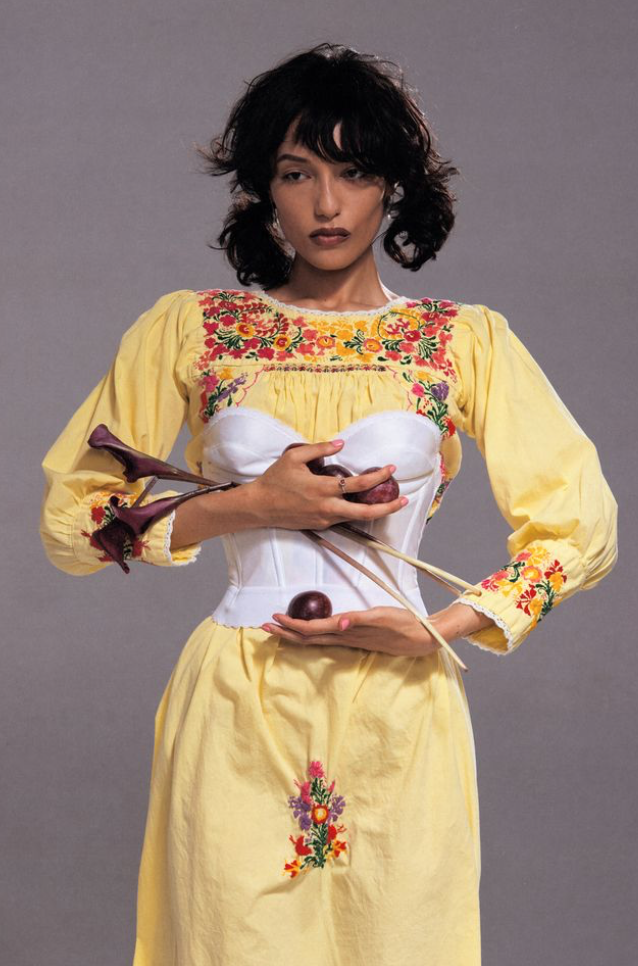
Rozie Ramati poses with plums. Photo by Kaio Cesar
In the heart of Downtown Los Angeles, independent Mexican-American musician Rozie Ramati is creating work that is as layered as the city that shaped her.
Released in late September, Ramati’s newest release, “Blinking Aisles”, is an artistic statement rooted in dual identity, historical memory, and unwavering humanitarian concern.
“Everything I make comes from that space of being in between," she said.
Growing up Mexican-American meant navigating a cultural limbo, never fully represented in mainstream American media or traditional Latinx narratives. Rather than shrinking from that ambiguity, Ramati has built a home within it.
Tristan Lai, the filmmaker behind the ‘Blinking Aisles’ music video, says what keeps him returning to her projects is her intentionality.
“Rosie has a story and a whole cinematic universe,” he said. “She sets the bar for the artists I work with.”
Ramati’s relationship with identity has always been complex and creative. Her early decision to cover “Bésame Mucho” marked a pivotal moment in her journey. Supported by friends and collaborators on pronunciation and authenticity, the release helped her embrace her own form of Mexican-American expression, even if her Spanish fluency wasn’t "perfect" by traditional standards.
Her family history, shaped by assimilation, has become a source of power.
“This isn’t a deficit,” she said. “It's a reflection of what happens when generations adapt to survive.”
For Ramati, Downtown L.A. has always played a formative role in her storytelling.
From childhood visits to Olvera Street and Chinatown, Ramati says the city is part of her narrative DNA. Her work is emotionally textured and grounded in the geography of her life.
Her latest work, “Blinking Aisles” blends surrealism and real-work symbolism to mirror her experience of being “in between.” Described as not partisan but still deeply political it critiques systems, honors legacy, and seeks to create space for others caught in cultural liminality.
Its release, however, was not without resistance.
Previous collaborators pushed for a diluted version of her vision, one that stripped the work of its context and symbolism.
But Ramati stood her ground and kept to her vision.
The project was delayed over a year, coinciding with the public domain release of Frida Kahlo’s work.
The “Blinking Aisles” album art draws direct inspiration from Kahlo’s Self-Portrait on the Borderline Between Mexico and the United States.
“It captured everything – industrialization, cultural duality, and that feeling of straddling two worlds,” Ramati said.
Together with photographer Kaio Cesar, she recreated the painting’s symbolic language using hand-painted digital backgrounds. The final image is a visual thesis on displacement and Mexican identity in the U.S.
Cesar recalls being struck by the precision Ramati brought to their very first conversation. “She already knew every single element that was going to go into the photo,” he recalled.
Lai was impressed with Ramanti's attention to her own artistic details and describes working with her as stepping into a fully realized world.
“She came in with a fifty-slide treatment,” he said. “Eveyrthing was there-the references, the meaning behind the lyrics, the visuals she saw in her head.”
That level of intention shaped every choice they made during two days of filming across Los Angeles.
The most striking moment came when they shot during an active anti-ice protest at Downtown L.A. City Hall.
“It wasn't planned. It was just real,” Lai said.
One thing Ramati has learned through her budding career is that in a world flooded with misinformation and performance activism it is important to make an active choice to trust her moral compass. One informed by history and sustained by the community.
“History is a play-by-play guide,” she said. “We’re not starting from zero. We’ve seen this before.”
Ramanti is committed to a kind of optimism that is strategic. Inspired by figures like Dolores Huerta, Ramati believes optimism is necessary for survival and for improving.
Now, Ramati is working towards an EP and a full-length album, prioritizing quality over speed.
As an independent artist, the risks are real. But in living between worlds she's created a world of her own.
“You have to anchor your morals. Write them down. Stick to them,” she said.