
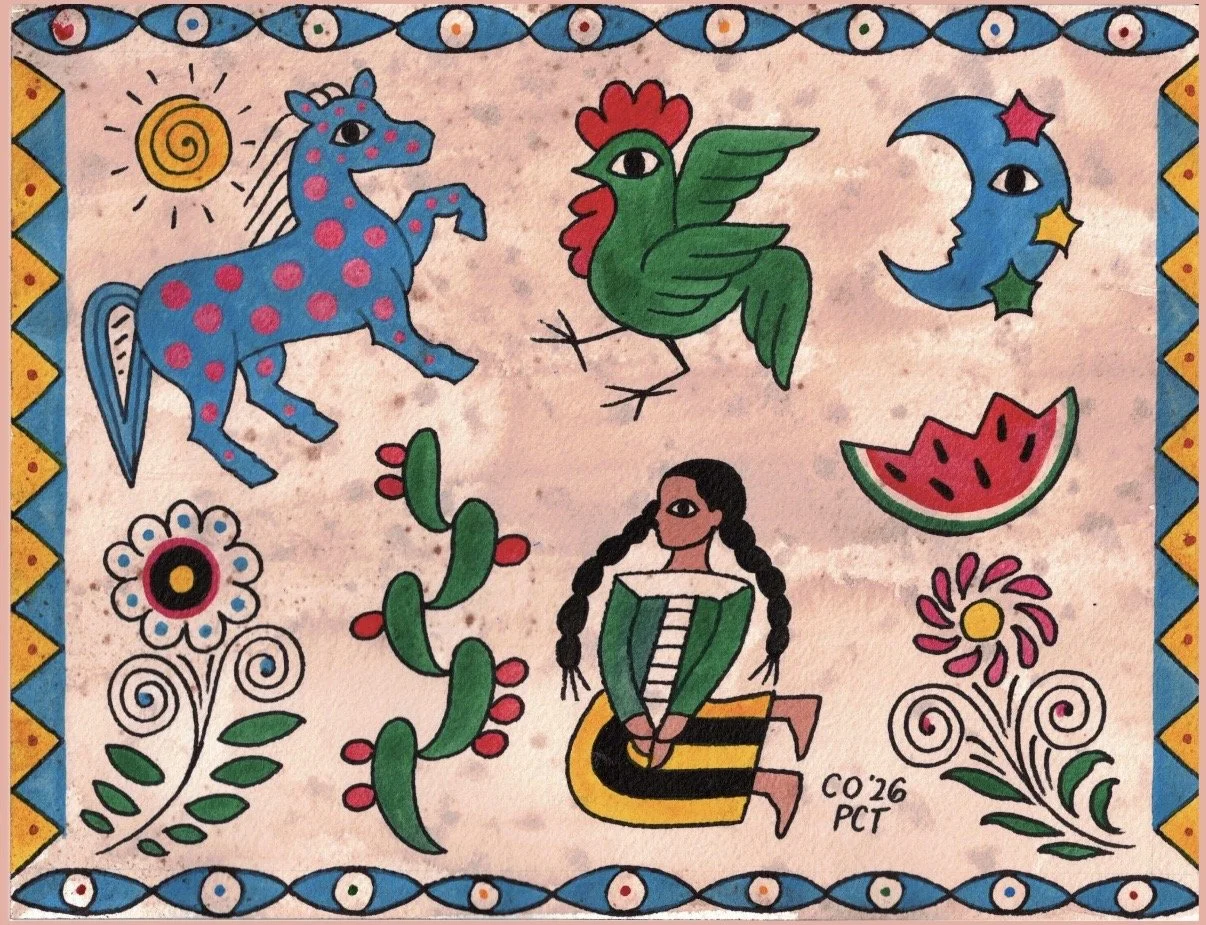
Some of the tattoos designed by Cindy Ortega, inspired by traditional Mexican cultures.
A fox stands on its hind legs, its chest puffed as if greeting the sky along with dozens of zoomorphic creatures posing like Mesoamerican deities. A siren raises her hands above her head while a two-headed woman appears to dominate the world around her with a glance.
These are some of the prints found in Long Beach tattoo artist Cindy Ortega’s flash sheets created to share profits with the Coalition for Humane Immigrant Rights (CHIRLA).
This sale, as other flash sales she’s coordinated, have been inspired by Mexican heritage and artists. For the CHIRLA sale, 30% of proceeds were donated to the organization to fund immigration resources and assistance.
But before her pencil strokes a new sheet, Ortega’s artistic process begins with research and context — each piece is an opportunity to learn.
“If I do put in that research and share what I find, then maybe I can help other people learn more about their own culture,” Ortega said.
Before earning her place at Paper Crane Studio in Long Beach, exhibiting her art in local museums and organizing flash sales to help people affected by ICE raids, Ortega was also a CSULB student with big aspirations, but many closed doors.
“I hate being told no. It makes me want to do things more,” Ortega said.
Ortega’s plans of becoming a biomedical illustrator were cut short when her school counselor broke the news that Ortega had reached her class unit cap.
She pivoted to a BFA in illustration, but was faced with many doubts after graduating in 2020 in the midst of a global pandemic.
While working as a barista, she decided to take a chance with tattooing – an art form she’d admired for years, but had not found the courage to pursue until she met another barista who was also a tattoo apprentice.
With a portfolio and a website mockup, Ortega visited several tattoo shops in hopes of a yes.
Eventually, her prints poked interest.
“This industry has historically not been particularly forthcoming about women's achievements,” Ortega said.
She said she aims to change the narrative of the creative spaces for historically marginalized groups, queer artists and others like her through cultural techniques. Several of her tattoos are inspired by other women and indigenous imagery.
This includes the amate paper hand-pounding methods of the Otomí people of Puebla, a process created by stripping the inner bark of a mulberry tree and pounding it with stone to create a drawing sheet.
“I’m educated on who's accomplished what, and always try to be learning more because I don't want to participate in that erasure,” Ortega said.
Just like the Otomí people used amate paper to record historically significant events, Ortega sees tattooing as an opportunity to help people connect with their culture.
“If you don't feel close enough to it, maybe this tattoo can help you get there, it's something you can wear that no one will ever take away from you,” Ortega said.
Like many Latine artists, Ortega talked about her insecurities in otherness, lingering in between both Mexican and American cultures.
Tatiana Sanchez, one of Ortega’s schoolmates at CSULB who also specialized in illustration, said she admires Ortega’s vulnerability as an openly queer artist who advocates through art.
“I just love the quality of research that she does and really captures a story,” Sanchez said. “She really utilizes history and knowledge to represent this single image.”
Although Ortega is meticulous about her research, she still struggles to find the balance within the confines of the negative connotations associated with tattoo culture, queerness, Latine communities and her family.
“This [tattooing] is something across the world that communities and people have done to mark rites of passage, to mark key events, and oftentimes the rites of passage specifically for communities,” said Felicia Montes, assistant professor of Chicano and Latino studies at CSULB.
In her work as a Xicana Indigenous artist and co-founder of creative women’s collective, Mujeres de Maíz, Montes spoke of Mexico City’s national arts school La Esmeralda, which classifies tattooing under the fine arts department.
“It's a fine art. It's been forever,” Montes said. “It's been relegated or marginalized, but it is an art form.”
Ortega has begun selling her prints at one of Long Beach’s oldest LGBTQ+ retail staples, Hot Stuff on Broadway. She is currently working on a print website to ship her orders and continue to build community through self-expression and conversation.
“Queer people, often, especially like Latina, queer, lesbians or anyone sapphic, when we get into those conversations, it makes me realize like your life and the way things panned out has been so similar to mine,” Ortega said, “It helps me be less hard on myself … lament less about things that seem to be cultural repetitions.”