
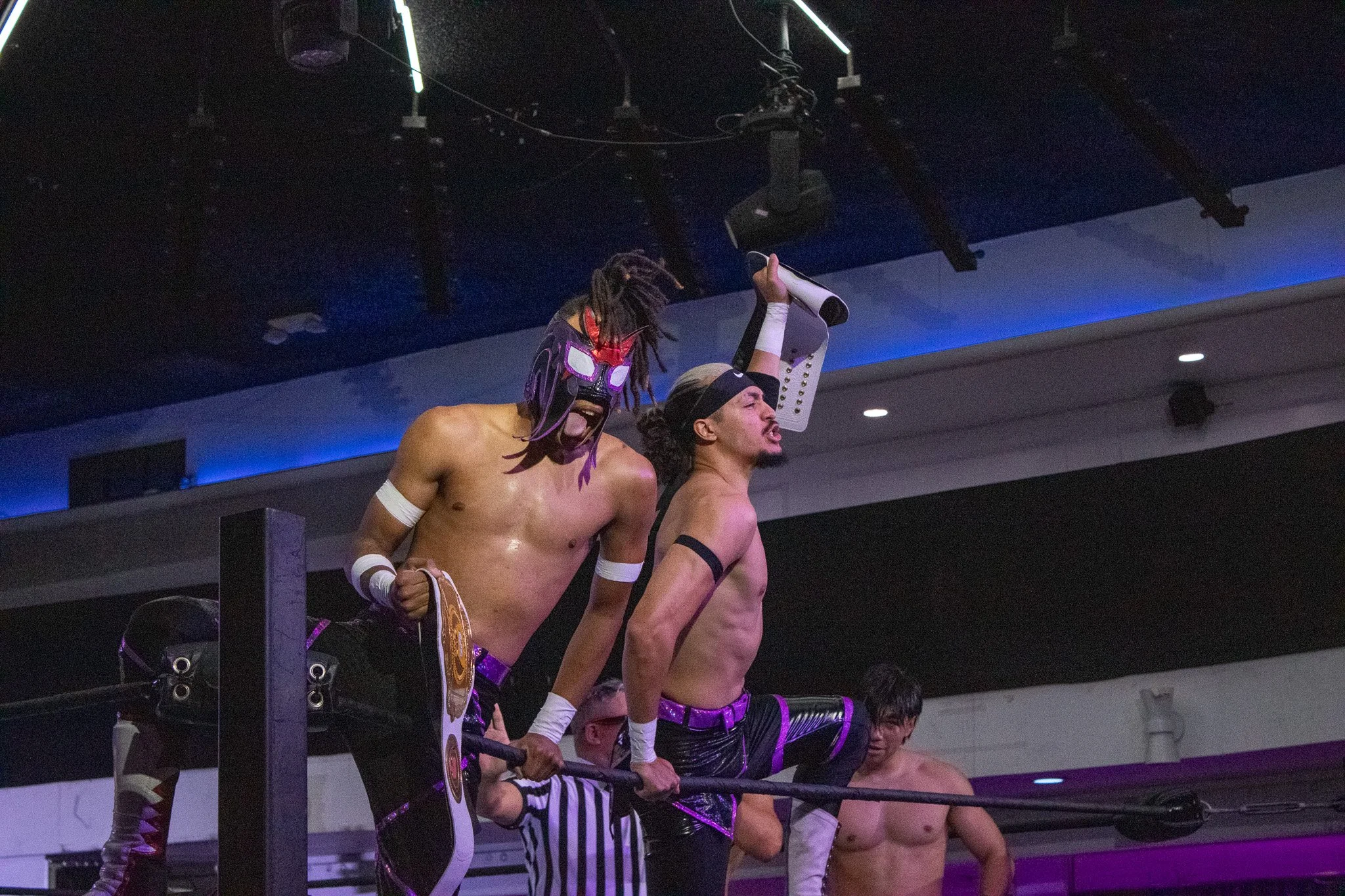
Luchadores at the “Alliance for All Wrestling” event in Long Beach on September 2026. Photo by Enrique Rivas.
Motivated by an energetic audience, a man puts on his mask — insecurities set aside for the crowd — the mask envelops him, motivates him and ties him to his roots. The indestructible Obsidian, as he calls himself, steps out to the ring and perches on the top rope, like an eagle standing over its native land.
It's been a packed few weeks for lucha libre, with events held in Boyle Heights and Long Beach through Alliance for All Wrestling and the Museum of Latin American Art.
“The story is told through acrobatics, and it's such a unique thing and because of the cultural significance of the idea of eagles, the Aztec warriors, how each of it requires, like a simplistic thing of flying, bringing it into the lucha libre,” luchador Obsidian said.
Lucha libre, which translates to free-style wrestling, is a regional style of professional wrestling within Mexico. According to “The History of Lucha Libre” and maskalucha.com, early lucha libre in 1910 was used as an escape for citizens during the Mexican Revolution against Porfirio Díaz.
Then, in 1929, Salvador Lutteroth González, a former revolutionary war lieutenant and regarded as the godfather of lucha libre, attended a wrestling show in El Paso, Texas. He was fascinated by its theatrics, athleticism and characters. He decided to bring this style of entertainment back to Mexico, and in 1933, with Francisco Ahumada, his business partner, founded the “Empresa Mexicana de Lucha Libre”, Mexico’s first wrestling company.
What separates lucha libre from American pro wrestling is its athleticism. Lucha libre is faster-paced, with wrestlers portrayed as superheroes who can soar with flying moves and feats of strength. The dynamics and characters engage audiences in the action and storytelling.
Another standout is the masked attire. The mask not only portrays their character through its color and design, but also the person behind it, while protecting their identity to preserve their character and separate their private life. This important tradition is why luchadores are not identified by their name.
“For me, I wear a closed mask that’s glittery because I am very shy still, even though I perform in front of so many people,” Obsidian said. “The mask is the best way for me to hide my insecurities, yet show how great I am in all the training and all the prowess I’ve learned throughout the years.”
The mask is sacred to a luchador, but also the key characteristic of lucha libre and what people identify the style with. It’s also what helps connect Obsidian to his Mexican heritage.
“Growing up as a Mexican American, especially on the ‘no sabo’ side, it is a lot harder for me to connect to that culture,” Obsidian said. “But lucha allows me to connect to that culture, whether it be through my body or through talking to people. It’s what helps me connect with people.”
Lucha libre is also viewed for its portrayal of resilience, an aspect that represents Chicano people, according to CSULB Chicano and Latino studies lecturer Maria Pacho.
“I’m going historically back to all the injustices, all the racism, environmental racism that took place in Boyal Heights, starting in the 80s with the No Prison in East L.A. to lineage. So you had all these people fighting, like luchadores … these people are ready to wrestle for their community to get justice, to get things done,” said Pacho.
This is shown through Barbie Boi, a wrestler and promoter for AFA wrestling. Barbie Boi started AFA to provide opportunities for LGBTQ+ wrestlers.
“I saw how wrestling can be. It was kind of tough for women and LGBTQ+ talent, and I felt there weren’t any safe spaces, or we weren’t treated equally,” Barbie Boi said. “So I wanted to create a space that was safe for us and for women’s wrestling, and create a spot that was home for people.”
Although Barbie Boi doesn’t wear a mask or think he’s a luchador, he still carries the luchador spirit by using his platform to inspire and entertain audiences and fellow LGBTQ+ wrestlers.
During an interview with ENYE, wrestlers kept stopping by to express their gratitude toward Barbie Boi.
“Being people’s inspiration is so wonderful and so humbling. I love when younger LGBTQ+ talent come to the show and say I inspire them to be who they are. That’s so special to me because I was afraid to be who I was for a long time,” Barbie Boi said. “I’m Hispanic, and I’m gay, and that’s already a tough thing to be in our world. But having the fans be so supportive, and everyone have so much fun, and all loving each other for who we are is so special. That’s what AFA is all about.”