
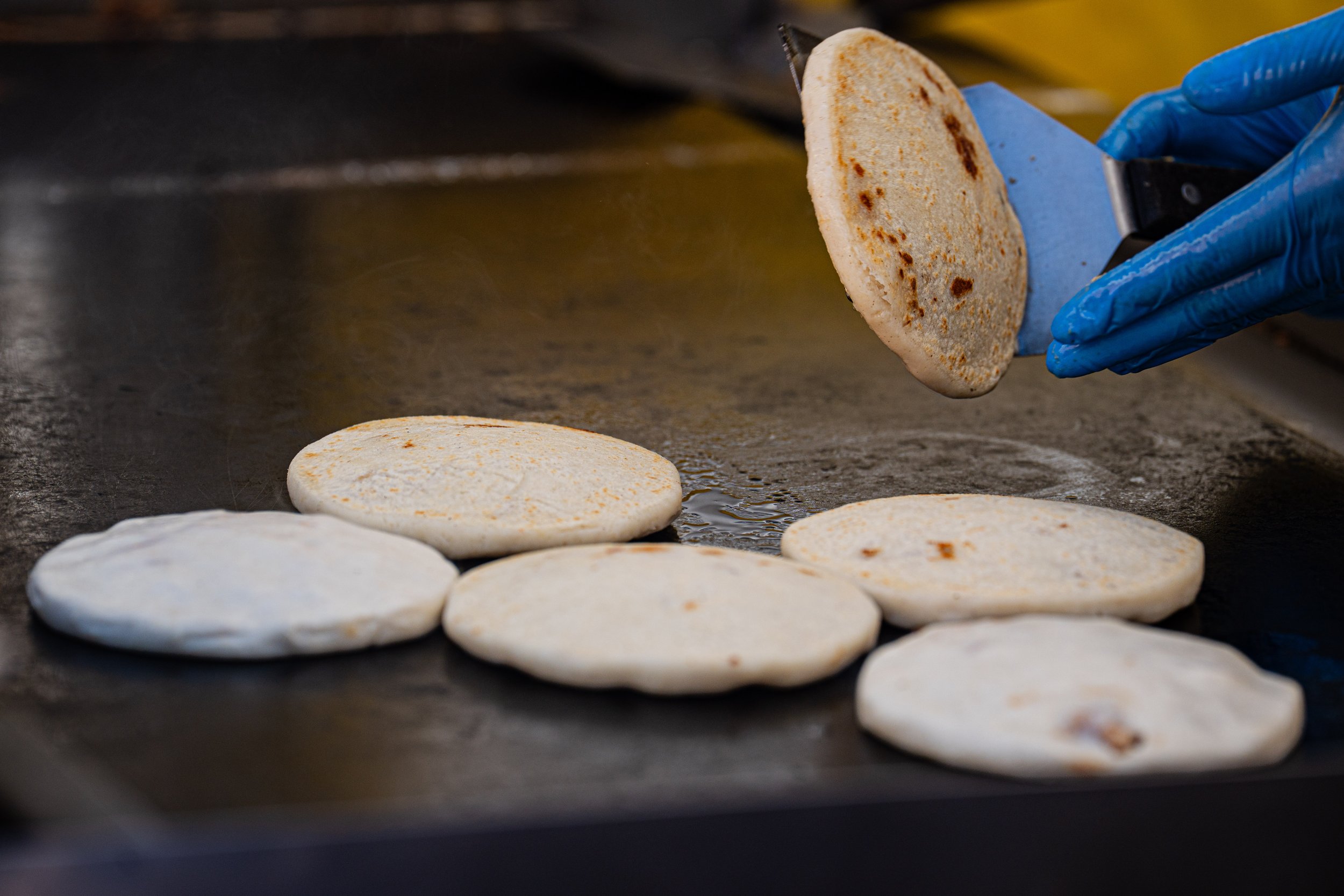
Jenny Calderon preparing pususas at her stand in CSULB. Photo by Diego Perez.
Pupusas are becoming the new trending street food with over 450 Salvadoran restaurants spreading across Los Angeles County. The dish can be found anywhere from street corners in Long Beach to 7-Eleven, Disneyland and even Dodger Stadium.
What started over 2,000 years ago as just a thick tortilla with beans inside has turned into one of the best-known dishes in Latin America.
“What makes the pupusa special is the way it is made,” said Jenny Calderon, pupusa vendor at CSULB. “The flavor is something different that you cannot find in other places.”
Calderon said more people really want to try pupusas. The wide variety of pupusa flavors include bean and cheese, revuelta (pork) and loroco, an unopened flower from a climbing vine with cheese.
The Salvadoran dish has taken the internet by storm in recent years. It started in the late 2010s when the National Restaurant Association named pupusas a trending “authentic street food” on its culinary forecast in 2018.
Tony Escoto, a Salvadoran Instagram influencer from Long Beach, says one of the reasons for the popularity is that El Salvador’s recognition and acknowledgment within the Latino diaspora has been growing in recent years. He believes this has resulted in a vast and trending knowledge about the dish.
“Second [reason]; because of said rising notoriety, there is a natural growing curiosity among people who have Salvadoran friends,” Escoto said. “Now that people are hearing more about El Salvador, they ask their friends about things like culture, traditions, and food is one of the easiest things to share.”
Social media in the late 2010s and early 2020s played a massive role in showing off pupusas to the rest of the world. Street vendors began to go viral on platforms like TikTok and Instagram.
In an interview with Univision, actor Leonardo DiCaprio answered that he is a “pupusa man” after being asked what his favorite Mexican dish is. DiCaprio added that they are better than tacos.
That clip alone made headlines and even inspired other trends, such as giant 12-inch-wide pupusas in Downtown Los Angeles.
Fernando Abarca, Salvadoran journalist for “Los Tiburones,” San Jose Sharks in Spanish, said people from different countries are becoming more curious about Salvadoran food.
“Social media has really helped introduce our food and culture to a much broader audience,” Abarca said.
Another trend, however, is the rise in pupusa prices. Since 2020, pupusa prices have gone from $3.50 to $5 each.
“Pupusa prices are going up in the U.S. due to the rising prices across the board under the current economic landscape,” Escoto said.
He also said prices in El Salvador are going up due to the big tourist boom of recent years.
“It isn’t that hard to get a foreigner with cash in their pockets to purchase good food at inflated prices while on vacation,” Escoto said.
Abarca said he believes inflation is one of the main factors as it pertains to the cost of ingredients, supplies and transportation. Most of the products used to make pupusas are either imported from El Salvador or other parts of Latin America.
“As they become more popular and more people want to try them, businesses will have to balance that growing demand with the higher cost of actually making them,” Abarca said.
Despite the mass inflation, local businesses continue to work and represent what their culture means to them, spreading the word of this classic Latino dish.
The Pipil, the original people of El Salvador, might’ve never guessed what was to come of their culinary creation thousands of years ago.
To support Salvadoran restaurants, visit:
El Torogos #2 on 14419 Pioneer Blvd., Norwalk, California.
La Pupusa Urban Eatery on 1051 W. Washington Blvd., Unit G, Los Angeles, California.
Pupuseria El Kiosco on 642 E. Artesia Blvd., Long Beach, California.