
Reconnecting With our Roots, a Voyage to the Past

Martin Espino, one of the musicians invited to perform Indigenous music from Latin America at the Aquarium of the Pacific in Long Beach. Photo by Melissa Luy.
The crowd sang in Mayan language, following the beat of drums and a Peruvian cumbia-style rhythm, Chicha. The man who led this performance is Martin Espino, 71, born in Los Angeles, an extraordinary musician with an extensive musical background in Indigenous music from Latin America.
“Ko'one'ex, Ko'one'ex, Palexen, Xik tu bin, Xik tu bin, Yokol k'in,” they sang a children's song, translating, “Let's go everyone, let's go now, the sun goes, it goes hiding.”
The lyrics of the first song are from the ancient Mayan, spoken in Mexico and Central America more than 5,000 years ago. There are around 768,379 speakers located only in Mexico, according to the National Institute of Statistics and Geography (INEGI). In his performance, Espino included Mayan, Nahuatl, and Spanish and educated people to preserve their heritage and culture.
Espino dressed in a beige hat and pants and wore unique orange-and-white sneakers, hand-painted with intricate Mayan symbols. His wrists were decorated with handcrafted bracelets, created by Mexican artisans, featuring scorpion and jaguar motifs.
While trying to warm up the crowd, Espino said, “When you sing with somebody or play with somebody, keeping the music going on, scientists say that each part of your brain becomes electrified again. Every sound that you hear right now, it goes to your brain like electricity. In other words, I’m lighting up your brain, it’s a beautiful thing! You’re recharging up!”
Espino’s extroverted energy invited people to be a part of his performance, from offering his hand-made drums to playing beats, and encouraging to sing alongside him. The music made the audience sing like the language was a part of them.
The performance took place at Baja Splash Cultural Festival in Long Beach’s Aquarium of the Pacific for Hispanic Heritage Month. Not only did he teach languages in his show, but he also played drums, flutes, and guitars, from different Latin American rhythms.

Instruments made from squash of different sizes selectively picked during season. They are drying, which is the first step in the process of making them. Photo by Melissa Luy.
His work includes: having written music for more than 20 films, helped in theater music production, made music for Disneyland Tokyo, sound effects for a video game, and released six music albums.
Espino’s parents were born in the United States, and his grandparents were born in Mexico, coming from Zapoteco and Coahuilteco heritage. He learned Spanish as a result of listening to his grandmother speaking it at home.
Regarding his roots, Espino recalled, “Nobody talked about that to me, my roots or who I am or where I’m from. My dad would talk about it every once in a while, but he never said, Martin, you’re Mexican, you’re part native. Didn’t you know that?” Growing up in the 60s, cultural and latino roots were not commonly represented in mainstream media.
During the 60s, he played rock and roll music with a band around East LA. Espino is the first of his family to pursue music as a profession, and it helped discover his identity along the way. Then, when he went to college, he found that there were no classes for electrical guitar except for classical guitar, so he decided to stick with it until he became a proficient guitarist.
While in school, Espino realized that Mexican music was not recognized as music from other countries.
“How come that everyone's music is okay and ours is terrible?How did they build pyramids that lasted until today? How did they make clothes and food that they eat, and the music was terrible? Something is wrong, so I started to do my research,” said Espino.
Through research, Espino concluded that what many are taught today, have either been written or influenced by the Spanish colonizers. Specifically, colonizers wrote degrading letters about indigenous people to the then king of Spain, Charles V.
“Mexico is beautiful. We have this beautiful called culture, and the rest of America is wonderful. It's the Spanish who were writing all this nasty stuff, and so that’s when I started appreciating my culture,” said Espino.
The book “Music in Mexico” by Robert Stevenson enlightened Espino with information that changed his perspective about ancient Mexico, which served as an inspiration for his music career.
After graduating with Honors in 1978 with a Bachelor of Music, he turned his career to spread awareness on indigenous music. Also to highlight the importance of people connecting with their own roots. Espino realized that many people were wrongfully criticizing Mexican indigenous people every time they listened to native music without knowing the real history and so he began educating them with facts.
During the 70s and 80s, people who immigrated to the U.S. were forced to suppress their native languages and assimilate to American culture. Espino mentioned people criticized immigrants who didn’t speak English at home and stuck to their community’s heritage.
Throughout his professional career, Espino has been very involved in the community, specifically by offering educational programs. Up until the Covid pandemic in 2020, he taught elementary school children to appreciate music from our ancestors via making native instruments and playing it to them. Now, he still teaches in different venues and festivals to people of all ages.
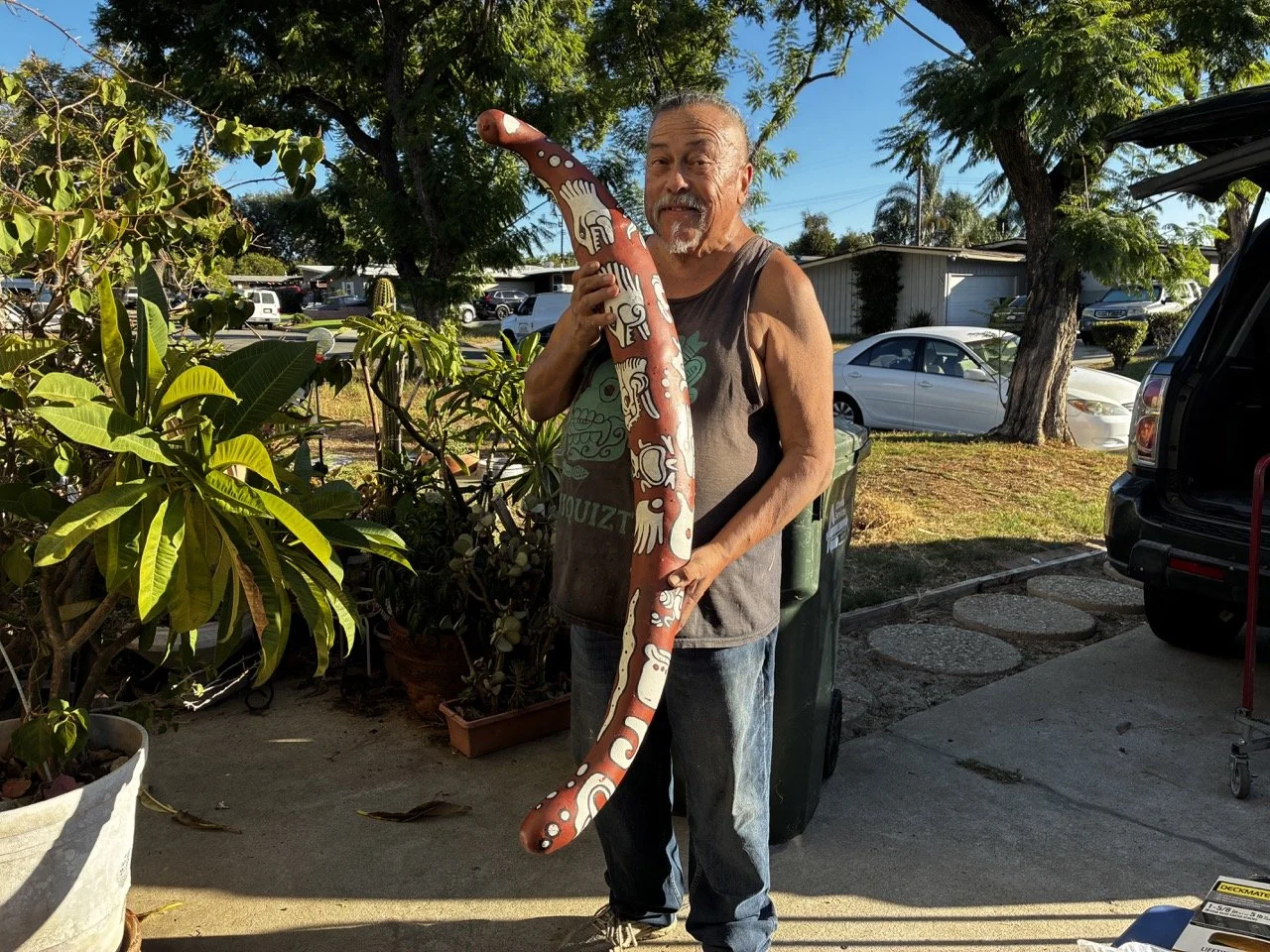
Espino proudly showed his rain stick instrument, hand-painted with Mayan hieroglyphs symbols that represent water. Photo by Melissa Luy.
He also performed his music in other countries and collaborated on composing music with different filmmakers, theater directors, and other musicians during his 59-year career. He collaborated in more than 20 movies, some notable ones being “Addam’s Family (1991),” “Shrek Forever (2010),” “The Old Ways (2021)”, “Backstreet to the American Dream (2021),” “Babylon (2024),” “Boundless Borders (2025),” etc.,
He’s released six albums: “Curandero (1998),” “Meditación Azteca (2018),” “Ek Balam (2012),” “El Dia de los Muertos (2010),” “Ancient California (2010),” and “Fire and Water (2020).” Some of his music is played on Pandora, like “Meditacion Azteca” and “Curandero.” He’s well known for being versatile, to experiment, and improvise on projects, independently and collaboratively, ranging from electronic music, Mexican indigenous music and different countries.
In 2012, filmmaker Patricia Nazario met Espino and invited him to compose music for her award-winning documentary, “Backstreet to the American Dream,” and to contribute music and voice work to festival-award animated short, “The Ancient History of Food Trucks.”
“I admire his creativity. I love how he uses natural resources to make instruments. I love that he participates in education, working with children and introduces them to music and instruments at such a young age. I love his soundbaths. I just admire how creative he is and how warm he is,” said Nazario.
Espino started meditating in his 20s, where he found that music can be a good complement to meditation. He wanted to differentiate other musicians who played the Native American flute or instruments from Tibet or India. He decided to include his culture, “Aztec Soundbath,” which brings a lot of benefits for mental and physical health, while also helping deepen one’s connection to the inner self.
Through a music group, Mexika, Espino had the opportunity to collaborate with other musicians. They performed traditional Indigenous Mexican music for 28 years. One of the members and close friend, Nazario Segura, was a dancer and drummer who shared the same interests and talents.
“Martin Espino is the creator of Mexika, and thanks to him I was inspired to join and become a member. The group Mexika is members collaborating with the love of our ancestors’ instruments. It brings us together in unity, to preserve our roots, traditions, and to bring self-meditation for all,” said Segura.
While performing with Mexika, Espino had the opportunity to play music with other South American musicians particularly those who performed traditional Andean music from Bolivia and Peru, playing popular songs, such as “Valicha” and "Condor Pasa,” for more than 38 years.
Some influential books to develop a deeper appreciation for his culture was reading Miguel Leon Portilla books, including “Aztec Thought and Culture,” and “15 Poets of the Aztec World,” where Espino discovered the poetry of Nezahualcóyotl. He was a king of Texcoco, Mexico City, in the 15th-century and was considered a man of divine wisdom.

Espino singing at the Baja Splash Cultural Festival in the Aquarium of the Pacific, Long Beach for the Hispanic Heritage month. Photo by Melissa Luy.
Espino wants to share his knowledge and inspire people to use music and heritage to learn their identity, “You know who you are, you know your name, you know what you like, you know what you don’t like, you know what you’ve learned. You know what you hate, you know what you love, but you’re not just that. You’re a part of the past. They’re all dead and gone, but there you look like the way you look because of those people in the past. So you’re connected to them and the foods you eat are the things they ate and you’re part of that whole time. And so how could anybody put that down when it’s part of us?”
Currently, he continues presenting his music in different locations, hosting his Aztec soundbaths around Orange and Los Angeles county. For more information, visit his website, https://martinespino.com/calendar.