Breaking Generational Cycles, One Degree At A Time
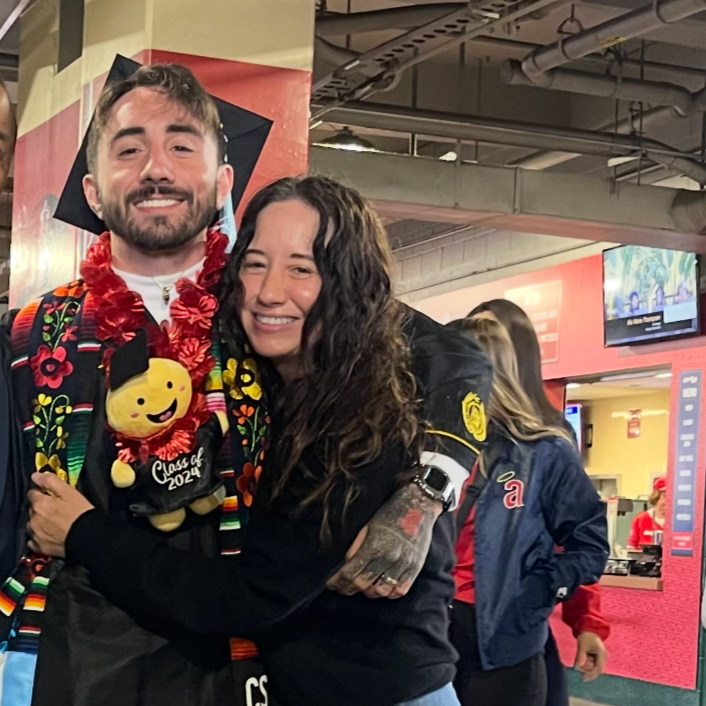
Manuela Cervantes is a former foster youth who became a mother at 15. This mother went back to college at the age of 40.
She is pursuing higher education with determination, once fueled by her survival. She is a transfer student from Long Beach City College in 2026 and is majoring in communication with a minor in law. She is expected to graduate in spring 2027.
“As a returning student, that identity is my foundation, it's the resilience and the ganas to keep fighting,” Cervantes said.
Growing up, Cervantes was in between two worlds. As a Latina navigating the foster care system, she often felt like she was balancing two identities that did not always fit together.
“My Latina identity was a source of both strength and complicity in the system,” she said. “I often felt caught between worlds, trying to hold onto my culture while navigating spaces that didn’t always understand it.”
First-generation students are defined as the first in their household to pursue higher education, but that doesn’t stop there. In some Latinx families, higher education becomes multigenerational, with their parents returning to school after their children graduate.
According to statewide data, Latinx students represent 48.9% of total enrollment. However, systematic barriers remain, particularly for students who have experienced being in foster care. Research from Annie E. Casey Foundation explains that only 8% to 12% of foster youth earn a two or four-year degree by their mid to late 20s, compared to 49% of young adults in the general population.
Those statistics felt personal for Cervantes.
“Navigating foster care as a Latina often meant feeling invisible,” she said. “The system wasn't built with cultural needs in mind.”
Cervantes remembers holding onto her culture in quiet ways. Through food, music and memories, because that was something the system could not take from her. Her life quickly shifted when she became a mom.
“It was no longer just about surviving. It was about building a future,” Cervantes said.
With every decision she made, even the hard ones, there was always one important question: Would this give her son a chance?
Education became both a path to stability and a way to show her son that their circumstances did not define their future. It became nonnegotiable.
Joshua Chacon, her son, majored in English education and earned his bachelor’s degree in 2023. Now, he is pursuing two master's degrees—one in library science and another in educational psychology.
“She said it was the most important thing I could get and that education is the only easy way to escape poverty,” Chacon said.
At only 16 years old, Cervantes enrolled her son in community college while he was still in high school.
“I’d say that instilled a sense of determination and importance in me,” Chacon said. “I knew by that time that I could do it and that it was extremely rewarding."
He remembers all the sacrifices she has made.
“She used to drive miles and miles to take me sometimes and spent so much of her time and money to get me through,” he said. “Sometimes, she even took classes with me.”
Now 25, Chacon says that his mom returning to college at 40 fills him with pride. “I was nothing but proud of her,” he said. “Now that I can support myself, I’m glad she can take the time to support herself. I’m her biggest supporter for education as she was for me.”
For Chacon, his mom returning to school represents something much bigger to him.
Eduardo Leyva, director of the Educational Opportunity Program (EOP) at California State University, Long Beach, said first-generation students often arrive motivated but unfamiliar with how to navigate higher education.
“Understanding what higher education is and what the expectations are can be one of the biggest challenges,” Leyva said. “They’re excited to be admitted, but once they’re here, they’re asking, ‘Now what do I do?’”
Leyva, was also a first-generation Latino student and said navigating financial aid and course registration can feel overwhelming, especially for students balancing family responsibilities.
“A lot of our Latinx students carry obligations at home,” he said. “They may be picking up siblings, working multiple jobs or supporting their families. That impacts how they experience the university.”
Programs like EOP and Guardian Scholars help by offering advising, financial literacy workshops and community support. For Cervantes, Guardian Scholars has been critical in her return to school.
“In a system that often made me feel like a case number, Guardian Scholars reminds me I’m a scholar,” she said. “We are not statistics, we are architects of our own futures.”