The Journey of Deaf Latinx Identity: Exploring the Cultural Crossroads
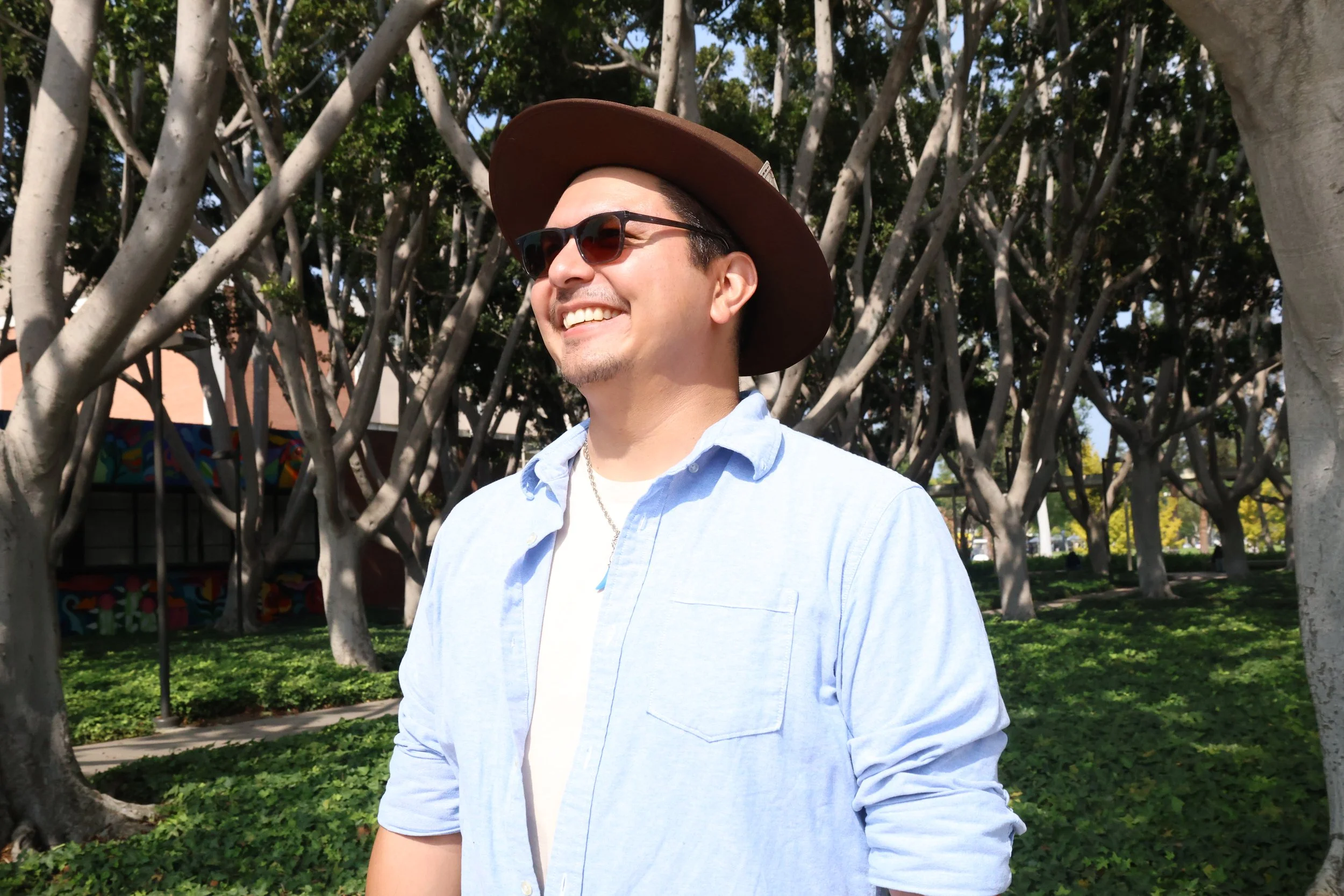
Portrait of Alan Carrera. Photo by Jake Padilla
Establishing an identity in the United States is complex for Latinx/e individuals – some feel secure in their identity, while others continue to explore it. Deaf Latinx/e individuals, however, face layered challenges navigating identity, language and cultural belonging, with limited support or resources.
The combined journey of Armando Castro Osnaya, M.S., and Nohemi Perez highlights both the struggles and resilience involved in bridging deaf, Latinx/e and American cultural worlds.
Castro Osnaya immigrated to the U.S. in his late teens from Puebla, Mexico, where Deaf education is minimal, and most students do not go beyond the sixth grade.
Perez grew up deaf in Tulsa, Oklahoma, a community focused on English and ASL. They emphasized the lack of Latine Deaf organizations in their hometown.
“There was just no discussion about learning the Spanish language, even though it was spoken in my home,” Perez explained.
Castro Osnaya faced significant challenges as he adapted to life in the U.S., navigating as a deaf Spanish-speaking person without language accessibility or access to American Sign Language (ASL). His transition from Spanish to English came with painful and cruel moments. Unlike in Mexico, he no longer had a supportive environment beyond his family, forming an isolating experience.
“The constant frustration, bullying and humiliation I faced while trying to speak English eventually led me to shut down and stop speaking altogether,” Castro Osnaya shared.
This adversity didn’t deter him from pursuing his education at Mount San Antonio College (Mt. SAC), where he was assigned a deaf counselor. However, he faced another obstacle. “Based on her last name, Gonzales, I assumed she spoke Spanish. To my surprise, she was a white woman in her 50s—deaf, but not Latina,” Castro Osnaya explained.
The counselor acknowledged his struggle to understand ASL. He never learned it and only knew a few signs in Lengua de Señas Mexicana (LSM), which were impractical and often neglected.
From the moment he attended the first class, he fell in love with ASL. He no longer had to rely on Spanish dictionaries, which provided him with a whole different level of access. “That made my transition to ASL both challenging and life-changing,” Castro Osnaya said.
Today, Castro Osnaya relies heavily on ASL and LSM in both his personal and professional life. He works as a freelance interpreter for deaf business owners. “I learned all of them, I teach all of them and they each serve a different role in how I connect with others,” Castro Osnaya highlighted his proficiency in English, ASL, Spanish and LSM.
While ASL also provided Perez with a strong educational foundation, there was a disconnect regarding their autonomy when cochlear implants were discussed during their Individualized Education Plan (IEP) meetings at school.
At an IEP meeting with their mother, interpreters and staff, Perez, who had used cochlear implants from age 5 to 12, already considered sign language their native language. Perez felt validated for the first time when an interpreter directly asked them if they were interested in taking a Spanish class.
“I actually craved it,” they said. “It made me more curious about learning more about my Indigenous identity.”
Perez deepened their knowledge of their heritage by learning Spanish and exploring Mexico's history, significant movements and Chicano culture. "...any language journey is tied to culture," they emphasized, “whether it’s Spanish, ASL, LSM or English.”
Perez’s introduction to LSM was influenced by trips to Mexico, visiting their deaf cousin, now a university professor specializing in LSM in Chihuahua. These visits, which started as family reunions, became the foundation for Perez’s learning.
“There are these warm memories…,” Perez remembered. “My deaf cousin in Mexico taught our hearing cousin the Mexican manual alphabet, and it allowed us to kind of bond while learning LSM. It was beautiful.”
Castro Osnaya described transformative moments with his family, crediting his siblings for his success. Their support allowed him to preserve his native language and enhance his reading skills through Spanish and English books. "I truly believe that everything that happened in our family happened for a reason," he said.
He often travels to Puebla to take part in Deaf sports events, coach a basketball team and oversee Grupo de Estudio LSM (GELSM), an online school. GELSM provides LSM instruction from native signers across Mexico and welcomes professionals, interpreters, organizational leaders and anyone interested in Mexican Deaf culture and language.
“Staying connected and active in the LSM community is one of my top priorities, both personally and professionally,” Castro Osnaya emphasized.
Perez’s first significant connection with a broader Deaf Latine community came after moving to Los Angeles. Perez discovered organizations like Deaf Latino y Familias, which supported Spanish-speaking parents of deaf children by promoting accessible and culturally relevant communication—a cause very close to their heart. “It was incredible,” Perez shared. “It was a way to pass down our culture in a way that was completely accessible in your language.”
Perez reflected on the similarities between Mexican and Deaf cultures, through gestural communication common among Latine growing up in Los Angeles. “It’s such a different vibe because…you understand each other and you can be yourself and be seen.”
Communicating with trilingual sign language speakers was a wonderful experience for Perez, who described their time in Tulsa as “only a bilingual experience: it was ASL and English. So, part of who I am was lost in a sense.”
The cultural gestures and signs Perez brought from their parents' Spanish-speaking home were dismissed at school. In contrast, deaf Latine peers recognized and interpreted these cultural nuances, validating aspects of Perez's identity that were previously ignored.
Castro Osnaya’s journey as a deaf Latino in the U.S. has also been one of cultural navigation and growth. Meeting his deaf American wife at Mt. SAC marked a significant point in embracing both their shared and differing cultural experiences.
“It has been a long journey, but a meaningful and rewarding one,” he reflects.
His evolving identity shows his dedication to honoring diverse elements of himself. “I’m Mexican, I use LSM, I teach ASL and I incorporate American culture and values. All of these layers have helped me feel deeply connected to a broader, multicultural Deaf community in the U.S.,” all while staying connected to his roots.
Castro Osnaya is supportive and acknowledges the diverse experiences of deaf individuals across Latin America and the U.S. “Other Latin American countries also have their own unique sign languages, such as Lengua de Señas Colombiana, Lengua de Señas Nicaragüense and Lengua de Señas Salvadoreña,” he explained.
Today, Castro Osnaya and Perez teach ASL at California State University, Long Beach (CSULB), helping the next generation of students explore Deaf culture, language and involvement.
Castro Osnaya noted the growing interest in LSM. Beginning in Spring 2026, CSULB will offer LSM Level 1 and Level 2 courses.
Alan Carrera, a CSULB graduate with a degree in ASL Linguistics, focusing on Deaf Culture and ASL-English Interpreting, is among the students who have begun learning LSM.
“Language is deeply connected to community and culture, and I want to preserve that connection as part of my identity as a Latino,” said Carrera.
Through his study of ASL and exploration of LSM, Carrera described his experience of uncovering "the layers of cultural richness that many people are still unaware of."
He was uncertain about his career path before learning sign language to help his friend study for her ASL midterm. Now, he is focused on earning a certificate in LSM from Mexico and working with the Deaf community there.
“I am returning to my roots,” Carrera said.